
VIP member
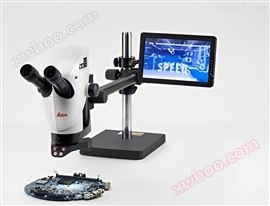
S9 series Leica microscope
The S9 series Leica microscope is a high-performance microscope product with excellent imaging quality and precise measurement performance, suitable f
Product details
The S9 series Leica microscope is a microscope product launched by the famous German optical instrument brand Leica. It adopts Leica's design concept and mature optical technology, with excellent imaging quality and precise measurement performance, suitable for observing and analyzing the fine structures of various materials.
Its appearance is simple and elegant, equipped with a precision microscope base and adjustable bracket, which can adjust the height and field of view angle according to different observation needs. The microscope head adopts an accurate spherical illumination system with high resolution, high brightness, and adjustable light source intensity, which can achieve clear observation and imaging of fine structures.
The optical system of the S9 series Leica microscope consists of components such as objective lens, eyepiece lens, compensating plate, polarizer, and filter. It adopts Leica's proprietary non coaxial optical path design, which can eliminate optical axis offset and reduce light leakage, improve imaging clarity and resolution. At the same time, this microscope also supports polarization observation, which can observe the color and texture of crystals and crystal structures, which is beneficial for material analysis and research.
The control is very convenient, with the upper computer control and on-site display covering the entire process, and can support various microscopic image processing functions, making it easy and fast to measure and analyze. At the same time, this microscope also has high sensitivity and stability, which can adapt to various complex observation environments and material properties, making it convenient for users to use and operate.
S9 series features:
1. Optimize optical inspection
The S9 stereo microscope has different models to meet various needs, which can improve the efficiency of production lines or quality control departments and optimize optical inspection. The reason is that:
FusionOptics integrates optical technology with a 12mm depth of field, allowing for quick discovery of details;
With a magnification of up to 55x and a 9:1 zoom ratio, it enables quick switching from overview to detail;
122mm working distance, easy to adjust the sample under the microscope;
Integrated network camera for easy graphic sharing.
2. 3x increase in depth of field for faster detection of details
Slide the slider and see for yourself how FusionOptics can capture detailed and clear images with maximum resolution and greater depth of field, achieving goals that other standard stereomicroscopes cannot achieve.

3. Quick switching of magnification
By using the Gao 9:1 zoom ratio, operators can effortlessly switch from overview to detail, improving inspection and adjustment speed.
Multi chromatic aberration correction variable magnification optical element, 55x magnification, revealing new details of the sample.

4. Easily adjust samples at maximum working distance
All S9 stereomicroscopes use a working distance of 122mm, allowing for convenient sample inspection and adjustment under the microscope.

5. Leica S series: S9 and S APO
S9 E: Ordinary Optical Mirror Inspection
S9 D: with camera and recording port
S9 i: Equipped with an integrated camera for digital image sharing
APO: With a magnification of 80x, it can be easily filtered and classified

6. S9 i: with integrated camera
The S9 i stereo microscope is equipped with an integrated 10 MP CMOS camera and can be connected to an Ethernet production network. The results can be quickly and reliably archived in video or graphic format.

7. S9 D: with camera and recording port
The S9 D allows you to flexibly add microscope cameras and turn them into digital microscope solutions. The internal 50:50 split light path allows for simultaneous observation of the eyepiece and digital imaging.
8. S9 E: Used for checking and repeating work improvement routines
The S9 E is a valuable device for conducting stereomicroscope examinations. It is known for its low price and high cost-effectiveness. Like all other S9 stereomicroscopes, it has the following characteristics:
12mm depth of field and FusionOptics fusion optical technology, quickly obtaining results in a natural viewing experience;
6.1x-55x magnification and 9:1 zoom ratio enable quick switching from overview to details;
122 mm working distance for convenient and ergonomic microscope operation;
Lock aperture function, which can be used in conjunction with replicable zoom settings;
Multi chromatic aberration correction optical element to reduce color stripes.
9. Greenough stereomicroscope with superior S APO magnification
The Greenough stereomicroscope S APO has a chromatic aberration reduction ratio of 8:1 and a powerful magnification capability of up to 80x, making it an ideal choice for quality control, cell sorting, and microinjection applications.

10. Easily change the observation field of view
The digital functions of S9 i, S9 D, and S APO eliminate the need to choose between screen and eyepiece. You can quickly scan the sample through a large screen image and then view the details through a microscope eyepiece.

11. Efficiently engage in life science research using the S9 series
From specimen cutting and preparation to sorting and screening of model organisms, the S9 series can improve your work efficiency in various life science jobs.
Easy training: Multiple configurations of plug and play cameras or integrated cameras add rich content to training and sharing.
Easy recording: Leica software enables fast, easy, and repeatable measurement and record archiving.
Usage:
1. The correct method of using the eyepiece
The eyepiece is the connecting component between the lens barrel and the observer's eyes. Simply push them into the tube to use.
The wearer of glasses must remove the eye cup or fold it back (as shown in the picture below), otherwise they cannot see the complete field of view.
2. The correct method for adjusting pupil distance
When observing the sample, if a circular image area is seen, it indicates that the pupillary distance has been correctly set.
(1) Slowly approach the eyepiece with both eyes.
(2) Move the lens barrel closer or farther apart with both hands until both eyes see a circular image area without shadows.
3. Correct focusing method
Use a focusing driver to lift the stereo microscope for focusing. Once the sample enters the focal point of the objective lens, the details of the sample will be clearly presented. The focusing driver can be operated with both hands.
(1) Place the sample under the objective lens and align it with it.
(2) Set low magnification level.
(3) Observe through the eyepiece and move the required sample details to the center position.
(4) Use the drive knob to focus on the sample.
4. The correct method of doubling
(1) Observe through the eyepiece.
(2) Focus on the sample.
(3) Rotate the multiplier until the desired magnification is configured.
Online inquiry
-
Contacts
-
Company
-
Telephone
-
Email
-
WeChat
-
Verification Code
-
Message Content
-