Product Information
When using ordinary material reaction tubes to store or incubate biological samples, up to 90% of the samples will be lost within 24 hours due to adsorption on the plastic surface. Eppendorf LoBind low protein adsorption tubes can significantly reduce the adsorption of samples and plastic surfaces, thereby achieving higher sample recovery rates. By using carefully selected two-component ultra pure polymer materials to create hydrophilic surfaces, we ensure that your precious samples achieve higher recovery rates. The Eppendorf LoBind low protein adsorption tube is suitable for protein research or sensitive proteomics detection, and can significantly improve the accuracy of experimental results.
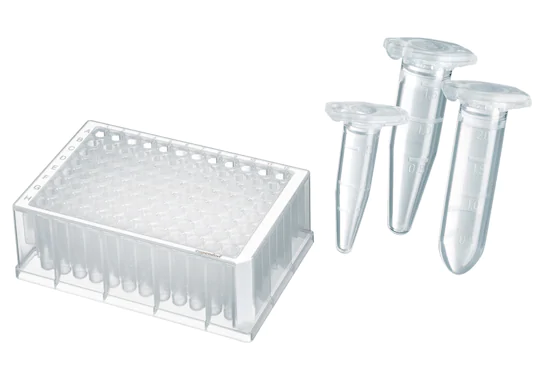
Eppendorf Protein LoBind products
These products include test tubes, microporous plates, and deep hole plates, which can meet different application requirements for various sample sizes and fluxes.
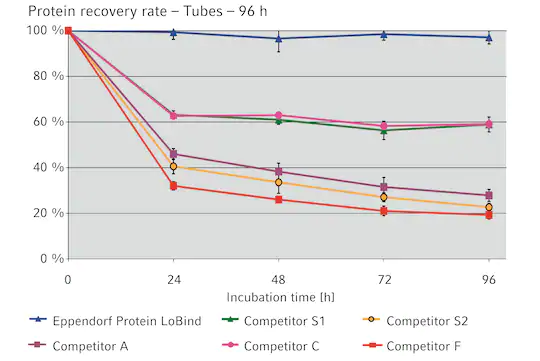
After 96 hours of cultivation, compared with other low adhesion test tubes,
Eppendorf LoBind low adsorption material ensures greater sample recovery and improves detection results. (For more information, please refer to the 180th issue of the application literature).

MALDI-TOF analysis
The use of Eppendorf Protein LoBind tubes produces significantly stronger signals during MALDI - compared to the use of standard tubes, TOF analysis of peptide angiotensin I. Under 1 pmol conditions, analysis cannot be performed using standard microtubes. Arrows indicate the signals in each experiment. (Source: Dr. S. Seeber and Dr. Humeny, School of Biochemistry, University of Erlangen Nuremberg, Germany. For more information, see 180 for more details)