
VIP member
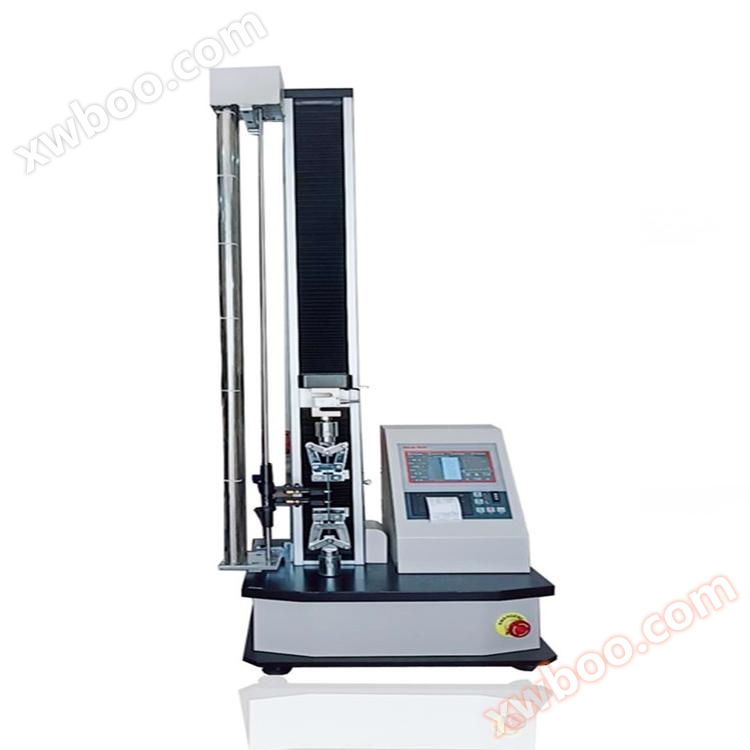


Manufacturer direct sales rubber tensile testing machine, small electronic tensile testing machine, rubber tensile testing machine
Manufacturer direct sales rubber tensile testing machine, small electronic tensile testing machine, rubber tensile testing machine
Product details
1、 Overview:
This machine can perform tensile, compressive, bending, tearing, 90 ° peeling, 180 ° peeling, shear, adhesive force, pull-out force, elongation at extension and other tests on rubber, plastic, foam materials, plastics, films, flexible packaging, pipes, textiles, fibers, nanomaterials, polymer materials, composite materials, waterproof materials, synthetic materials, packaging tapes, paper, wires and cables, fiber optic cables, seat belts, safety belts, leather belts, shoes, tapes, polymers, spring steel, stainless steel, castings, copper pipes, non-ferrous metals, automotive parts, alloy materials and other non-metallic and metallic materials.
2、 Host specifications:
A. High precision force sensor: 0-2000N (optional interval)
The power accuracy is within ± 0.1%.
B. Capacity segmentation: Seven levels throughout the process: * 1, * 2, * 5, * 10, * 20, * 50, * 100
Adopting high-precision 24 bits A/D with a sampling frequency of 200Hz
Full power resolution of 1/1000000
C. Power system: Haide servo motor+Haide servo driver+ball screw+smooth rod linear bearing+synchronous belt drive.
D. Control system: using Pulse Command control method to make control more precise
The speed control range is 0.01~500 mm/min.
Zhonglian board adjustment has fast coarse adjustment and slow fine adjustment functions.
Automatically return to the origin and store after testing.
E. Data transfer method: USB transfer
F. Display mode: UTM107+WIN-XP test software computer screen display.
G. A concise linear dual correction system with full range one gear and precise full range seven gear force.
H. The luxury testing interface software can achieve control modes such as fixed speed, positioning movement, fixed load (with adjustable holding time), fixed load increase rate, fixed stress increase rate, and fixed strain increase rate, as well as multiple control modes to meet different testing requirements.
I. Testing space: Testing width of approximately 400 mm (standard specification)
The upper and lower space of the connecting plate is 800 mm (excluding fixtures) (standard specification)
J. Full displacement: Encoder 2500 P/R, improving accuracy by 4 times
The LINE DRIVE encoder has extremely strong anti-interference ability
Displacement analysis 0.001mm.
K. Safety devices: overload emergency stop device, upper and lower travel limit device, leakage automatic power-off system, automatic breakpoint shutdown function.
3、 Software Function Introduction:
A. Modular functionality of testing standards: providing users with the ability to set tests for the required applications
Standard setting, covering GB, ASTM, DIN, JIS, BS, etc. Test standard specifications.
B. Sample data: Provide users with the ability to set all sample data and input it at once
Data reuse. And the formula can be self modified to improve the fit of the test data.
C. Dual report editing: Fully open for users to edit reports for testers to choose from
Favorite report format (test program adds built-in EXCEL report)
The editing function has expanded the previous pattern of single professional reports
D. The lengths, force units, and display digits are dynamically interchanged, with force units of T, Kg, N, KN, g, and lb and deformation units of mm, cm, and inch.
E. Auto Scale for Graph Curve Scale, which enables graphs to
Scale display. And it can dynamically switch graphics in real-time during testing. tool
There are load displacement, load time, displacement time, stress-strain
Load -2-point extension diagram and multi curve comparison.
F. The test results can be presented in EXCEL format
Output according to form.
G. After the test is completed, it can be automatically archived or manually archived. After the test is completed, the force, upper and lower yield strengths, hysteresis loop, stepwise approximation method, non proportional elongation strength, tensile strength, compressive strength, fixed elongation strength at any point, fixed load extension at any point, elastic modulus, elongation, peel interval value, minimum value, average value, net energy, folding energy, total energy, bending modulus, breakpoint displacement x% load, breakpoint load X% displacement, and so on can be automatically calculated.
Data backup: Test data can be saved on any hard drive partition.
H. Language: Simplified Chinese.
I. The software has the function of demonstrating historical test data.
4、 Testeable items:
(1) Common testing items: (common display values and calculated values)
● Tensile stress ● Tensile strength
● Tensile strength ● Tensile elongation
● Constant tensile stress ● Constant elongation at constant stress
● Fixed stress value ● Tear strength
● Force value at any point ● Elongation at any point
● Extraction force ● Adhesive force and peak calculation value
● Pressure Test ● Adhesive and Peel Force Test
● Bending test ● Pull out force puncture force test
(2) Special testing items:
1. Elastic coefficient, also known as Young's modulus of elasticity
Definition: The ratio of the normal stress component to the normal strain in the same phase. To determine the coefficient of material rigidity, the higher the value, the stronger the material.
2. Limitation: Within a certain range, the load can maintain a proportional relationship with elongation, and its stress is called the specific limit.
3. Elastic limit: The stress that a material can withstand without deformation.
4. Elastic deformation: After removing the load, the deformation of the material completely disappears.
5. Deformation: After removing the load, the material still retains deformation.
6. Yield point: When a material is stretched, the deformation increases while the stress remains constant, and this point is called the yield point. The yield point is divided into upper and lower yield points, and generally the upper yield point is taken as the yield point.
Yield: When the load exceeds the proportional limit and elongation is no longer proportional, the load will suddenly drop, and then fluctuate up and down over a period of time, causing significant changes in elongation. This phenomenon is called yield.
7. Yield strength: The quotient obtained by dividing the load at which the elongation reaches a certain specified value during stretching by the original cross-sectional area of the parallel part.
8. Spring K value: the ratio of the force component in phase with the deformation to the deformation.
9. Effective elasticity and hysteresis loss:
On a tensile machine, when the sample is stretched at a certain speed to a certain elongation or to a specified load, the percentage of the recovered work during shrinkage and the consumed work during stretching is measured as the effective elasticity; The percentage of the energy lost during the elongation and contraction of a sample compared to the work consumed during elongation is called hysteresis loss.
5、 Main counting indicators:
A. Load element: optional in the 0-2000N range
B. Power resolution: 1/50000
C. Power accuracy: ≤ 1.0%
D. Power amplification factor: 7-segment automatic switching
E. Displacement resolution: 1/1000
F. Displacement accuracy: ≤ 0.5%
I. Speed range: 0.1-500mm/min (special testing speeds can also be customized according to customer needs)
J. Effective walking space: 800mm (excluding clamps, special testing space can also be customized according to customer needs)
K. Power supply: Φ 220V50HZ.
L. Power: Approximately 400W
M. Machine size: approximately 520 × 390 × 1560 mm (length × width × height)
N. Machine weight: approximately 100kg
Online inquiry
-
Contacts
-
Company
-
Telephone
-
Email
-
WeChat
-
Verification Code
-
Message Content
-