
VIP member
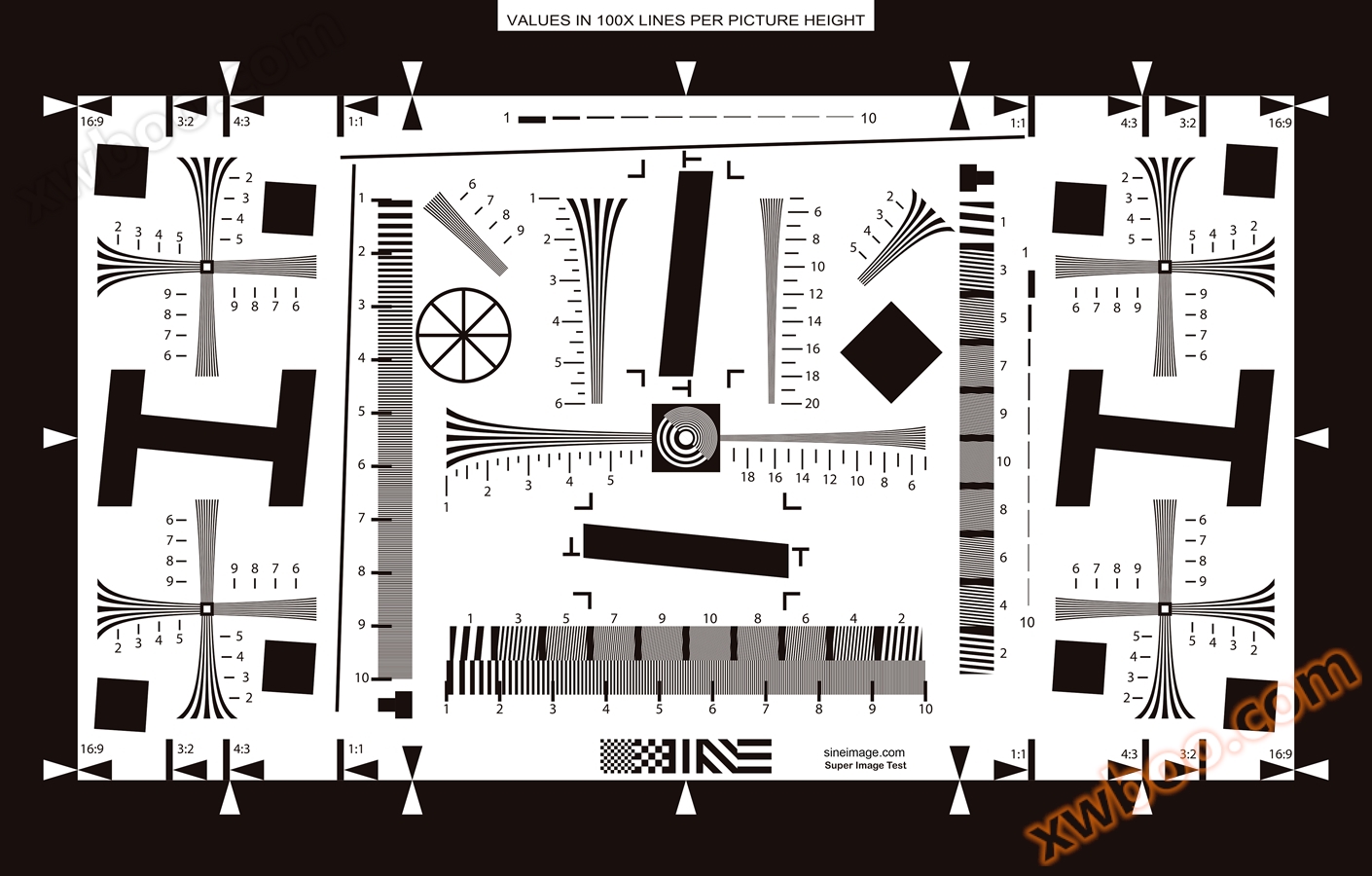
ISO 12233 standard resolution test card
Brand: Sine Image Model: 0.5x, 1x, 2x, 4x, 8x (customizable) Material: HD photo paper, imported film Ratio: 4:3/16:9 Optional Type: Reflective/transmi
Product details
ISO12233 resolution card, ISO12233 resolution card (0.5x, 1x, 2x, 4x, 8x) with 2000 lines
ISO12233 resolution card (0.5x, 1x, 2x, 4x, 8x), testing lighting source, testing software, providing a full range of one-stop professional services.
purpose
Resolution card (resolution card) is a standard sample that can provide auxiliary testing such as vertical resolution and horizontal resolution for actual shooting.
The resolution test was conducted using the international standard ISO12233 resolution card, with a unified shooting angle and shooting environment.
The calculation of resolution was carried out using HYRes software, which separates vertical resolution and horizontal resolution.
The evaluation of digital cameras is different from other products, unlike laptops, DIY, etc. which have a large amount of software to test objective data, which can explain everything from the data. Evaluating the quality of a digital camera requires not only objective data, but also practical usage and sample photography. Therefore, our evaluation is based on the principle of objective data, combined with the rational analysis of experienced evaluators, in order to obtain the most objective evaluation results.
The ISO 12233 standard resolution test card follows the 12233 standard "Photography - Electronic Photographic Images - Measurement Methods". In this active area of 1 X size, measuring a height of 20 cm has an error of only about 0.1 millimeters. He possesses almost all the characteristics of resolution cards.

Common standard specifications
ISO12233 Resolution Test Card
0,5X (10x17.8 cm), semimatt (normative contrast), image on photographic paper
0.5 times matte (standard contrast) high-definition photographic paper
Product NO. : NQ-10-50A
1X (20x35.6 cm), semimatt (normative contrast), image on photographic paper
1.5 times matte (standard contrast) high-definition photographic paper
Product NO. : NQ-10-100A
2X (40x71.1 cm), semimatt (normative contrast), image on photographic paper
2.5 times matte (standard contrast) high-definition photographic paper
Product NO. : NQ-10-200A
4X (80x142.2 cm), semimatt (normative contrast), image on photographic paper
4 times and a half matte (standard contrast) high-definition photographic paper
Product NO. : NQ-10-400A
8X (160x284.4 cm), semimatt (normative contrast), image on photographic paper
4 times and a half matte (standard contrast) high-definition photographic paper
Terminology and definitions
1. Resolution: The limit of being able to distinguish fine patterns, except for jagged edges. Expressed as the number of lines per unit height of the screen.
2. Sawtooth: When the sampling frequency is less than twice the highest frequency of the image signal, noise with overlapping waves will be generated near the high-order harmonics of the sampling frequency.
Shooting conditions

1. Lighting: According to ISO7589 regulations, the light source adopts "daylight" (standard specification) or "tungsten filament lamp". Provide sufficient illumination for the chart to ensure that the camera can output signals. When lighting, ensure that the difference in illumination between any part of the chart and the central area is within a range of+-10%. Be careful not to let the light from the illumination source directly enter the camera lens. Place objects with low emissivity around the chart to minimize the impact of reflected light.
2. Framing composition: When placing the chart, make it parallel to the focal plane of the camera, and make sure that when viewed horizontally, the thick horizontal frame is parallel to the horizontal frame of the image. According to the regulations of 12233, the effective height of the chart (the height inside the thick box when viewed horizontally in Figure 4.1) should occupy the entire image during shooting Actually, it is somewhat difficult to shoot exactly according to this requirement, so it is also possible to shoot slightly smaller. At this point, multiply by "the number of vertical pixels of the entire image/the number of pixels per effective height of the chart in the image" to specify.
3. The principle of camera condition setting: When measuring resolution according to this standard, the camera parameter principle actually adopts the factory settings. When measuring with settings other than the factory settings, the settings used must be indicated. If there are parameters that cannot be determined based on the factory settings, the manufacturer will measure them according to the settings that the camera user is most likely to use, and indicate the information that can determine the setting.
4. The exposure conditions are not specifically set
5. Focus: No special settings
6. White balance: The camera's white balance must be adjusted appropriately relative to the lighting source.
7. Zoom position: not specifically set
Measurement conditions
1. In order to minimize the variability of the evaluation using printed images, the following two points are used as evaluation criteria.
a) The spatial frequency at which the number of wedge-shaped lines in the visual resolution evaluation pattern changes (such as from 5 to 4) is used as the resolution. The unit is represented by the number of bars per height.
b) When observing, please make sure to start tracking from the low-frequency side, and the printing frequency can be set to any value.
2. In order to minimize the variability of the evaluation using display images, the following two points are used as evaluation criteria.
a) The spatial frequency at which the number of wedge-shaped lines in the visual resolution evaluation pattern changes (such as from 5 to -4) is used as the resolution. The unit is represented by the number of bars per height.
b) When observing, please make sure to start tracking from the low-frequency side. The magnification (zoom) of the display screen can be set to any value.
Resolution testing charts from different eras

Why develop different resolution testing methods when MTF can determine the resolution of cameras and lenses? This question is very good, MTF theory has been tested and verified to be correct! But the key lies in the sample map captured! Due to the limitations of the output device, MTF test images composed solely of lines are essentially restricted. When DSLRs with up to 10 million pixels are released, such as the Nikon D2X or Canon EOS 1Ds MKII, their shooting resolution has already surpassed the performance of traditional film (traditional 135mm film was defined as about a thousand pixels in the past). In other words, when the progress of the equipment begins to exceed the limits of USAF1951 and ISO12233, the test actually no longer has relative significance.
New Standard for SFR American Measurement
New term SFR! Spatial frequency response (SFR) is mainly used to measure the impact of increasing spatial frequency lines on a single image. In short, SFR is a simplified version of MFT. Because measuring MFT requires obtaining expensive sine samples and converting a large amount of data. Therefore, PIMA developed this lower cost SFR as an alternative. Basically, SFR only requires a two tone black and white diagonal line (as shown in the left figure below) to convert a resolution evaluation map that is approximately equal to the value of MFT.

Online inquiry
-
Contacts
-
Company
-
Telephone
-
Email
-
WeChat
-
Verification Code
-
Message Content
-