
VIP member

HP-DK65M microphone array module
The HP-DK65M microphone array module integrates algorithms such as noise suppression, reverberation suppression, echo cancellation, and fixed beam, wh
Product details
1. Overview
This document describes the hardware introduction, interface specifications, algorithm functions, installation instructions, and related design considerations of the HP-DK65M microphone array kit product, which is used to guide development and design.
2. Design principles
In typical environments, noise always comes from all directions and crosses the frequency spectrum of speech signals. In addition, the effects of reverberation and reverb make it very difficult to capture pure speech using a single microphone.
This product adopts a 4 or 8 microphone array and integrates algorithms such as noise suppression, reverberation suppression, echo cancellation, and fixed beam. It can effectively extract the speaker's speech in noisy sound field environments and reduce the interference of surrounding environmental noise. At present, it is widely used in smart finance, smart services, smart cars, smart homes, robots and other scenarios, and can provide corresponding solutions.

Figure 2-1 Design schematic of HP-DK65M microphone array kit
3. Terminology analysis
Table 2-1 Terminology Analysis List
|
Serial Number |
function |
describe |
|
1 |
AI noise reduction |
Suppress steady-state noise and non-stationary noise |
|
2 |
Directional pickup |
Pick up sound within the beam range, with adjustable pickup range |
|
3 |
Speech Enhancement |
Enhance speech within the beam range |
|
4 |
Echo cancellation |
Eliminate the playback signal from the recording |
|
5 |
Reverberation suppression |
Suppress environmental reverberation |
|
6 |
Adjustable pickup distance and range |
Adjust different pickup distances and ranges according to different scenarios |
|
7 |
Linear microphone |
4 or 8 microphone heads form a linear layout |
4. System framework

Figure 4-1 System Framework Diagram
As shown in Figure 4-1, the system framework consists of 2 acquisition boards and 1 main board. The multi-channel audio from the microphone acquisition board is input to the main board through an FPC cable, and the processed audio from the main board can be output to the user device through USB_SUDIO.
5. Hardware configuration and inventory
The hardware design adopts modular design principles, which are simple and easy to use. The motherboard supports multiple peripheral interfaces, including USB Audio, Lineout, and serial ports for output audio. It is drive free and can support systems such as Windows, Linux, and Android. The hardware configuration list is shown in Table 5-1, and the hardware inventory list is shown in Table 5-2.
Table 5-1 Hardware Configuration List
| Serial Number |
name |
describe |
|
1 |
system |
Linux System |
|
2 |
Memory |
128MB DDR3+128MB FLASH |
|
3 |
cpu |
ARM@ A7, Dual core, 1.2GHz main frequency |
Table 5-2 Hardware List
| Serial Number |
name |
describe |
|
1 |
MIC1_Board |
Collection board 1, 4 digital microphones |
|
2 |
MIC2_Board |
Collection board 2, 4 digital microphones |
|
3 |
MB_Board |
Main control board, running algorithms, outputting audio processed by algorithms |
|
4 |
10pin-0.5mm FPC ribbon cable |
Connect the acquisition board and motherboard, with a cable length of 30cm |
|
5 |
Power supply/USB audio line |
5PIN-PHS 2.0mm interface |
|
6 |
Mining line |
4PIN-PHS 2.0mm, Line length 80cm |
6. Physical display
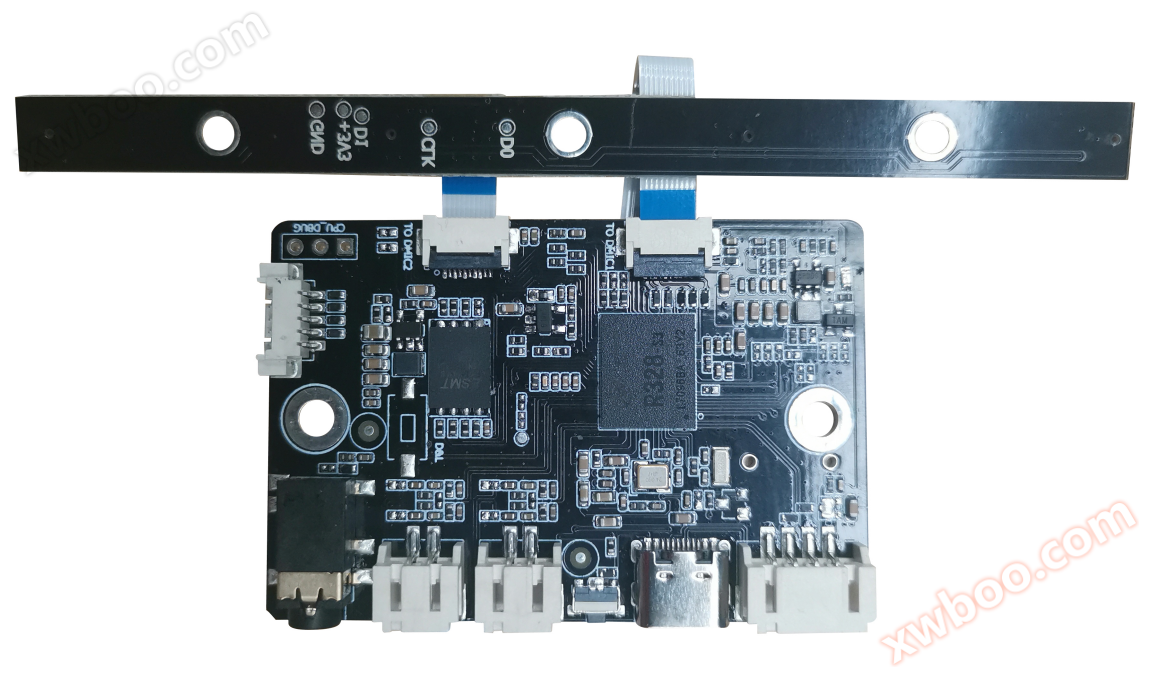
6.1 Physical dimensions of linear acquisition board

The size of the linear acquisition board is 110mm * 8mm * 1.2mm;
The distance between adjacent screw holes is 35mm; the distance between adjacent microphones is 35mm.
6.3 Physical dimensions of motherboard


7. Design of Microphone Array Structure
7.1 Overall Design Requirements
(1) The microphone should be tightly attached to the inside of the casing and wrapped in a silicone sleeve for sealing and cushioning.
(2) Keep the microphone away from the speaker or vibration source, and try to keep the microphone away from the speaker or away from the speaker.
(3) The microphone should be installed on the same plane as much as possible (the casing may have a certain curvature).
(4) Eliminate resonance of the shell or cavity caused by the horn.
7.2 Schematic diagram of microphone sealing

(1) The reference value for the diameter of the sound hole is 1-1.5mm.
(2) The depth of the sound hole should not exceed 3mm.
Note: The dimension A in the above figure is the hole depth, including the thickness of the shell and the thickness of the silicone sleeve.
(1) The reference thickness of MIC's silicone sleeve is about 1mm, and after compression, it is about 0.5mm.
(2) The silicone sleeve should be tightly attached to the shell.
8. Software performance indicators
The performance indicators of software algorithms are as follows:
| Echo cancellation performance and resource consumption | Performance (ERLE) | CPU usage (Mips) | RAM usage (M) |
| Circular Eight Wheat | Letter to reply ratio increased by>40dB | 150 | 0.42 |
| Linear eight wheat | Letter to reply ratio increased by>40dB | 150 | 0.42 |
| Intra beam noise suppression | Performance (ERLE) | CPU usage (Mips) | RAM usage (M) |
| non-stationary noise | Signal to noise ratio improvement>15db | 35.8 | 0.33 |
| stationary noise | Signal to noise ratio improvement>20db | 30 | 0.29 |
| Reverberation suppression performance and resource consumption | Performance (ERLE) | CPU usage (Mips) | RAM usage (M) |
| Reverberation delay<600ms | The signal-to-noise ratio has increased by more than 10db | 248.3 | 0.63 |
| Reverberation delay<900ms | The signal-to-noise ratio has increased by more than 8db | 480.4 | 1.64 |
| Overall algorithm performance | Audio restoration degree | delay |
| Circular Eight Wheat | >97 | <200ms |
| Linear eight wheat | >95 | <200ms |
9. Frequently Asked Questions Q&A
1. Q: What is the pickup range of the product? Is the pickup range adjustable?
A: The circular microphone has MIC1 (0 degrees/360 degrees) as the origin and an effective pickup range of ± 30 degrees; The linear microphone has a 90 degree origin and an effective pickup range of ± 30 degrees. The pickup range can be adjusted.
2. Q: What is the pickup distance of the product? Is it adjustable?
A: The optimal pickup distance for the product is between 20cm and 300cm, and the pickup distance can be changed by adjusting the gain.
3. Q: Are there any requirements for the installation and placement angle of the collection board?
A: The circular collection board is installed on the horizontal plane of the user's device, with the microphone head facing upwards and the MIC1 direction facing the user; The linear microphone acquisition board can be installed on the horizontal, inclined, or vertical surface of the user's device.
4. Q: What is the audio format of the input motherboard? What is the output audio format of the motherboard?
A: The audio format input to the motherboard is 16k sampling rate, 16 bit, 6-channel (8-channel recording signal+2-channel recovery signal), pcm; The audio format output from the motherboard is: 16k sampling rate, 16 bit, mono, PCM raw data.
5. Q: Does the product support echo cancellation? How to achieve it?
A: The product supports echo cancellation. Simply connect the left and right playback signals of the speaker to the left and right channel interfaces of the acquisition board using the mining line.
6. Q: What are the advantages of HP-DK65M microphone array kit compared to other microphone arrays?
A: HP-DK65M supports outputting analog and digital audio signals; Supports both circular and linear eight microphone arrays to meet the needs of different products and scenarios.
Online inquiry
-
Contacts
-
Company
-
Telephone
-
Email
-
WeChat
-
Verification Code
-
Message Content
-