
VIP member
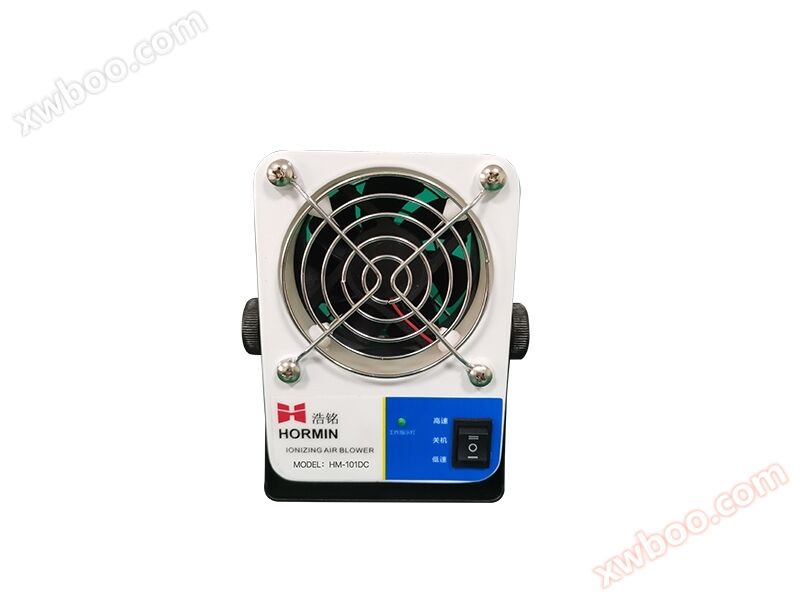
HM-101DC Miniature DC Ion Fan
Principle and application range of DC ion fan HM-101DC miniature DC ion fan can generate a large amount of airflow with positive and negative charges,
Product details
Principle and application scope of DC ion fan
The HM-101DC miniature DC ion fan can generate a large amount of airflow with positive and negative charges, which can neutralize the positive and negative charges carried on objects. When the surface charge of an object is negative, it attracts positive charges from the airflow; When the surface of an object carries a positive charge, it will attract negative charges in the airflow. When equal amounts of positive and negative charges come into contact, electrical neutrality can be achieved. DC ion fans are suitable for providing a wide range of anti-static areas, fast anti-static time, and stable ion balance voltage in clean rooms.The HM-101DC miniature DC ion fan can eliminate or neutralize static electricity in a wide range of concentrated targets or hard to contact areas. It is an ideal static eliminator for precision electronic products, electronic assembly, pharmaceutical manufacturing assembly, packaging, and small product molding. Mainly applicable to industries such as pharmaceutical equipment manufacturing, electronic assembly production lines, microelectronics manufacturing, and precision electronic assembly production lines for LED, LCD, PCB, etc.
Product Features:
1. Quickly eliminate static electricity, the compact body is conducive to small space installation;2. Suitable for internal installation of machinery and equipment, as well as static electricity removal in the production process of precision small parts;
3. External 24V safety power supply.
Technical specifications
| Model (Model) | HM-101DC |
| Input voltage | DC 24V |
| Power Consumption | 10VA |
| Operating temperature | 0℃~50℃ |
| Dimensions (Size) Excluding Bracket | 90mm(L)x50mm(W)x130mm(H) |
| Weight (weight) | 0.7KG |
| Air Volume | 30-70 CFM |
| Ion balance | ≤±10V |
4、 Decay Test Results
| Testing Conditions | Test Voltage:+1000V~100V, -1000V~100V |
|
Environmental temperature (Temperature) 5 ℃~25 ℃ Relative humidity (RH) ≤ 60% |
||
Test distance 300mm |
||
Decay Time |
正1.7s |
Negative 1.8s |
Offset Voltage |
≤±6V |
≤±7V |
Note:
1. The test data is based on the results of the ME-268A electrostatic tester.2. The speed measurement data may vary due to the ambient temperature and humidity during testing.
5、 Operation
This fan has two wind speeds to choose from: high and low.6、 Safety instructions
1. The socket connecting the fan must be reliably grounded.2. Do not insert anything into the air outlet.
3. Do not operate the fan in flammable and explosive environments.
4. Unauthorized repairs are not allowed.
7、 Maintenance
1. Ionic fans are designed with the goal of regular maintenance and low repairWhen using an ion fan, the ion needle of the ion fan continuously ionizes the air and generates positive and negative charges, making it easy for the ion needle to adsorb small dust particles in the air, thereby reducing the effectiveness of the fan in removing static electricity. Therefore, it is necessary to regularly clean and maintain the ion fan (the maintenance cycle depends on the usage environment)
Maintenance items: Cleaning of the launch head, calibration of ion balance, calibration of electrostatic discharge time. Clean the launch head at least once every two weeks, and regularly calibrate the ion balance and electrostatic discharge time to ensure the normal operation of the ion fan.
1. Cleaning of the transmitter
To clean the emission point of the transmitter, first disconnect the power supply of the ion fan and clean the emission needle with a cotton swab or dust-free cloth dipped in alcohol; Until the ion emission needle tip is cleaned thoroughly, at least once every two weeks.
2. Cleaning of air inlet and outlet
The air inlet network and ionized air outlet network should be kept clean to prevent blockage of airflow, and can be cleaned with a soft bristled brush or compressed air.
3. Ionic balance test
Measure ion balance (residual voltage) using an electrostatic analyzer.
4. Static elimination time test
Measure the static elimination time using an electrostatic analyzer.
5. The ion fan is designed to have a stable and fixed output of ions. Due to factors such as voltage fluctuations and humidity in the ambient air, there may be a deviation in ion balance (residual voltage). Offset standard: 0V ± 10V. If there is a significant deviation between the static elimination time and residual voltage, it should be sent back to the factory for calibration.
8、 Product Warranty and Service
Our company strictly adheres to the principle of product quality first, reputation first, and customer first, and makes the following commitments to our products1. Warranty period
The warranty period for products sold by our company is one year. Within one year from the date of sale, if there are quality problems caused by the product's own components, materials, or processes, our company will provide free repairs.
2. Services after the warranty period
After the warranty period of the products sold by our company, we are still responsible for repairing them free of labor costs to protect the interests of our customers.
Online inquiry
-
Contacts
-
Company
-
Telephone
-
Email
-
WeChat
-
Verification Code
-
Message Content
-