
VIP member
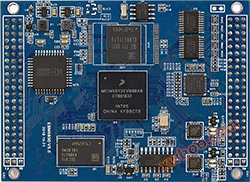
ESM6800 series industrial control motherboard
ESMARC series low-cost industrial control motherboard, Cortex-A7 processor, pre installed Linux-4.1.15 operating system, Modbus industrial control com
Product details
● Front view

Operating systems and development tools
| operating system | development environment | programming language | |||||
 
|
 |
 |
 |
||||
| Linux + Qt | Eclipse | C/C++ | Java | ||||

|
|
|
 |
||||
| Linux + X11 + Qt | Eclipse | C/C++ | JavaSwing | ||||
● Technical indicators
core unit |
Communication interface configuration |
|
● Cortex-A7 528MHz / 792MHz(iMX6ULL) 512MB DDR3 system memory, user available space of approximately 450MB 256MB NandFlash or 4GB eMMC FLASH memory ● Supports external MicroSD cards and external USB drives for high-capacity data storage ● Independent real-time clock RTC with power down protection function Hardware watchdog (WDT) to prevent system deadlocks ● Dedicated debugging serial port (115200, 8-N-1) |
● 2 Ethernet interfaces, 10M/100M adaptive ● Two CAN bus interfaces 12 standard UART serial ports 1 I2C interface, main control mode, maximum baud rate of 400kbps ● 1-channel 4-wire SPI interface, main control full duplex mode, maximum baud rate of 60Mbps ● 4-channel USB high-speed host interface (HOST) ● 1 USB-OTG interface |
Display unit |
Universal Digital IO |
|
TFT color LCD interface, 18 bit parallel RGB Supports resolutions ranging from 320 × 240 to 1024 × 768 ● Supports 4-wire resistive touch screen ● Video signal input interface (optional) |
32-bit general-purpose GPO0-GPO31, with independent and controllable direction of each I/O bit ● Support external interrupt triggering function, with effective rising edge ● 3.3V LVCMOS level After power on/reset, GPIO defaults to digital input mode |
Power supply and module mechanical parameters |
Basic software environment for Linux platform |
|
Working power supply voltage:+5V ± 10% Power consumption: 165mA/DC5V RTC backup battery voltage: 3.0V ● Working temperature: -00 ℃~60 ℃/-40 ℃~80 ℃ optional ESMARC architecture, motherboard dimensions: 74mm × 54mm ● 2 3 × 22 cores sturdyIDCSocket (2mm spacing) placed on both sides of the module ● Anti reverse insertion mechanism |
UBIFS root file system, regular startup takes 10 seconds, fast startup takes 3.5 seconds ● Eclipse integrated development environment based on Windows platform for direct application development ● NFS based on Windows platform makes program debugging extremely convenient ● Support conventional system debugging and management methods such as Telnet and FTP ● Pre installedModbus protocol stackSQLite3 database Support C/C++, Qt C++, and Java for developing applications ● Support users to modify the startup screen by themselves ● Source code of various typical application-oriented application frameworks |
● Model comparison
| ESM6800H | ESM6800E | ESM6800 | ESM6800L | |
| CPU | iMX6ULL,Cortex-A7 |
|||
| CPU clock speed | 792MHz | 792MHz | 528MHz | 528MHz |
| RAM | 512MB DDR3 | 128MB DDR3 | ||
| FLASH | 4GB eMMC | 256MB NandFlash | 128MB NandFlash | |
| LCD | 18-bit RGB | - | ||
| ETHERNET | 2 | 2 | 2 | 2 |
| USB HOST | 4 | 4 | 4 | 2 |
| USB OTG | 1 | 1 | 1 | 0 |
| SD | √ | √ | √ | √ |
| UART | 12 | 6 | 12 | 6 |
| CAN | 2 | 2 | 2 | 2 |
| GPIO | 32 | 32 | 32 | 32 |
● Mainboard schematic diagram

● Installation diagram

Online inquiry
-
Contacts
-
Company
-
Telephone
-
Email
-
WeChat
-
Verification Code
-
Message Content
-