
VIP member
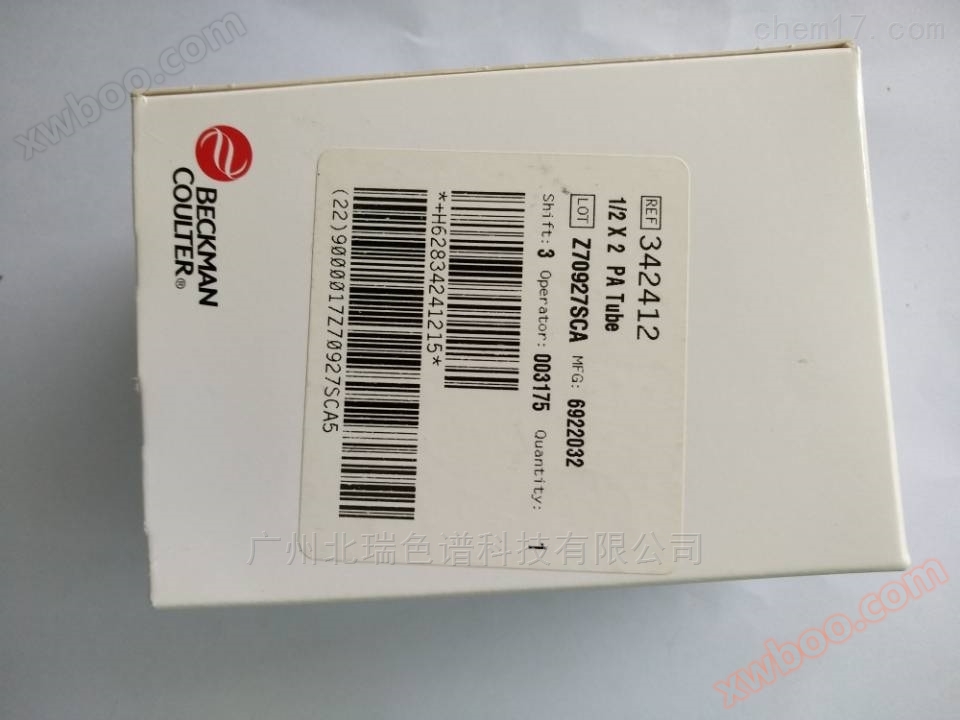
Beckman heat sealed fast sealing tube
Beckman heat sealed fast sealing tube
Product details
Beckman heat sealed fast sealing tubeBeckman fast sealed tube, Beckman heat sealed tube, Beckman Coulter centrifuge tube
Order number: 342412
Description: TUBES, QS PA 1/2 X 2 (BOX-50)
Material: PA
Delivery time: spot supply
Guangzhou Beirui Chromatography Technology Co., Ltd. specializes in providing various types of Beckman centrifuge tubes,Beckman heat sealed fast sealing tube.
If you need other models of Beckman Coulter centrifuge tubes, please call our company for inquiries.
Classification of centrifuge tubes:
- According to material, they can be divided into plastic centrifuge tubes, glass centrifuge tubes, and stainless steel centrifuge tubes. 2. According to speed, it can be divided into low-speed centrifuge tubes and high-speed centrifuge tubes. 3. According to capacity, they can be divided into microcentrifuge tubes, small capacity centrifuge tubes, and large capacity centrifuge tubes. Generally, centrifuge tubes with a capacity greater than 100mL are referred to as centrifuge bottles. 4. According to the shape of the centrifuge tube mouth, it can be divided into tapered centrifuge tubes and straight centrifuge tubes. 5. According to the shape of the bottom of the centrifuge tube, it can be divided into round bottom centrifuge tube, pointed bottom centrifuge tube, and flat bottom centrifuge tube. The function of a centrifuge tube is to prevent liquid leakage
2. According to the size, there are a large number of centrifuge tubes (500mL, 250mL), ordinary centrifuge tubes (50mL, 15mL), and micro centrifuge tubes (2mL, 1.5mL, 0.65mL, 0.2mL). The centrifuge tubes are made of materials [1], including plastic centrifuge tubes, glass centrifuge tubes, and steel centrifuge tubes. The disadvantages are easy deformation, poor resistance to organic solvent corrosion, and short service life. Plastic centrifuge tubes all have tube covers, which are used to prevent sample leakage, especially when used for samples with radioactivity or strong corrosiveness. Preventing sample leakage is very important; The tube cover also serves to prevent sample evaporation and support the centrifuge tube, preventing deformation of the centrifuge tube. When selecting this point, attention should also be paid to checking whether the pipe cover is tight and whether it can be tightly covered during the experiment to achieve inversion without leakage; We all know that in plastic centrifuge tubes, commonly used materials include polyethylene (PE), polycarbonate (PC), polypropylene (PP), etc. Among them, polypropylene (PP) tubes have relatively better performance. Therefore, when selecting plastic centrifuge tubes, we try to consider polypropylene plastic centrifuge tubes as much as possible. 2. When using glass centrifuge tubes, the centrifugal force should not be too high. Rubber pads are needed to prevent the tubes from breaking. Glass tubes are generally not used for high-speed centrifuges. If the sealing of the centrifuge tube cover is not good enough, the liquid cannot be filled up (for high-speed centrifuges and angle rotors are used) to prevent overflow and loss of balance. The consequence of overflow is contamination of the rotor and centrifugal chamber, which affects the normal operation of the sensor. When performing high-speed centrifugation, it is necessary to fill the centrifuge tube with liquid, as high-speed centrifugation requires high vacuum pumping, and only filling it up can prevent deformation of the centrifuge tube. 3. Steel centrifuge tubes have high strength, no deformation, and can resist heat, frost, and chemical corrosion. They are also widely used, but they should also avoid contact with highly corrosive chemicals such as strong acids and alkalis during use. Try to avoid the corrosion of these chemicals as much as possible.
Online inquiry
-
Contacts
-
Company
-
Telephone
-
Email
-
WeChat
-
Verification Code
-
Message Content
-